Best of Last Week – New ways to measure entanglement, hobbit mystery perhaps solved and how stress impacts longevity

Bob Yirka
Author
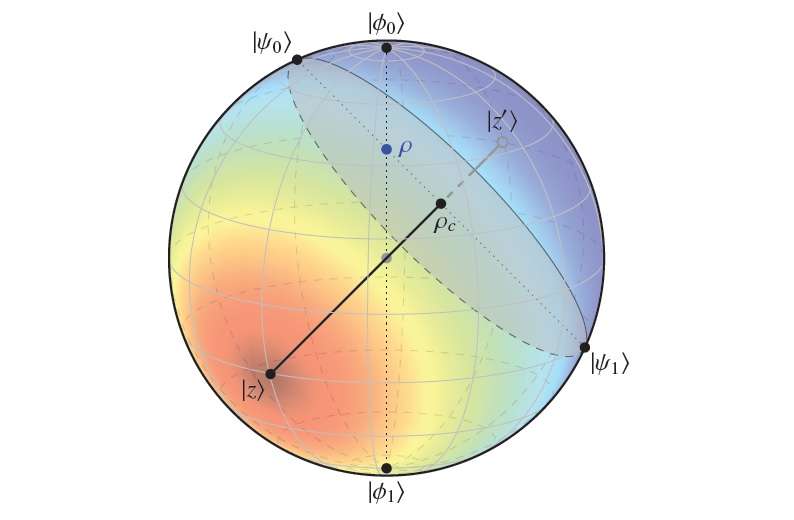
(Science X)—It was another good week for physics as an international team of researchers recorded the first video of the 100-nm space under an impacting Leidenfrost droplet—where a droplet appears to levitate on a hot surface. Also, a pair of researchers with The University of Nottingham announced that they had discovered an easy way to measure entanglement on a sphere, while another team in Europe laid out an idea for allowing the human eye to observe an instance of entanglement—by using a beam splitter and two beams of light, one of which would have only single photons. And another team with members from Canada and Australia devised a means for demonstrating 'quantum surrealism', in which quantum particle trajectories were tracked.
In other news, a team of researchers at the University of Southampton announced that they had developed an eternal 5D data storage medium that could record the history of humankind—based on a nanostructured glass, it could hold data for 13.8 billion years at room temperature. A pair of researchers working in France announced that the mystery 'hobbits' are not humans like us—they claimed to have found evidence that suggested that Homo floresiensis fossils found in Indonesia in 2003 represent a different species than Homo sapiens. And Samir Iqbal, an associate professor at the University of Arlington developed a device to diagnose cancer rapidly at the cellular level, which could help with early detection. Also, a team at Newcastle University led a study that found clear differences between organic and non-organic milk and meat—the organic foods had approximately 50 percent more beneficial omega-3 fatty acids than the non-organic foods. And another team working to unlock one of the great secrets of Earth's evolution found evidence that suggested that the Cambrian explosion was due to the unified geography of Cambrian Earth, when most of the planet's continents were clustered around the equator.
And finally, if you are someone who is often under pressure and worrying about what it might be doing to you, a team of researchers with Stanford University asked, does stress cause premature DNA aging? They conducted the largest study to date on the idea, and their findings might surprise you.
